
Review · HIKING & TREKKING
Rwenzori Mountains Trekking with Margherita Peak Summit
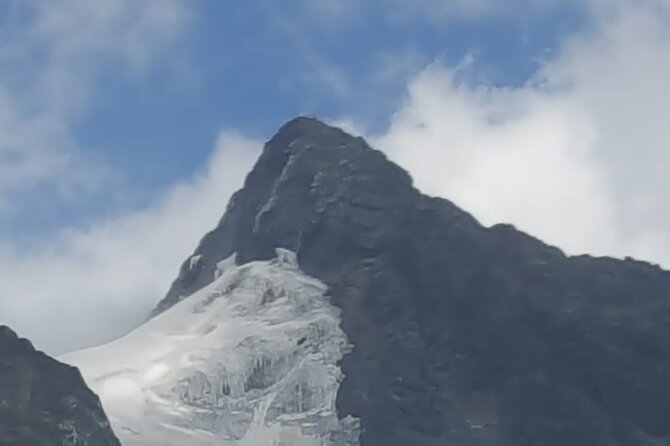
The mountains save their biggest test for the top. This seven-day Rwenzori trek takes you from farmland and thick forest to bogs, giant lobelias, glaciers, and Margherita Peak at 5,109 meters. I like the route because it offers remarkable changes in vegetation and a real high-altitude summit attempt, rather than a simple mountain walk. I also like that the private trip includes transport, guides, huts, and all meals. The main caution is clear: this is a demanding mountaineering trip, and climbing gear is not included.
The $1,400 price can be good value if you need a fully arranged expedition with meals, park access, transport, and support. I would not treat it as a casual holiday, though. Long days, wet bogs, steep rock, cold conditions, altitude sickness, and glacier travel all feature in the plan. The strongest praise has focused on professional, flexible support, with guides and drivers including Johnson and Geoffrey receiving special thanks.
In This Review
- Five things to know before you book
- Why the Rwenzoris feel unlike an ordinary African trek
- Day 1: Nyakalengijja to Nyabitaba Hut
- Day 2: Bamboo forest, slippery rock, and John Matte Hut
- Day 3: Bujuku Lake and a shorter acclimatization day
- Day 4: Groundsel Gully and the cold Elena Hut
- Day 5: The Margherita Peak summit attempt
- Day 6: Freshfield Pass and the route toward Guy Yeoman
- Day 7: Completing the circuit at Mihunga Gate
- What the $1,400 price gives you
- The support people praise most
- Who should book this trek?
- Booking details worth checking first
- Should you book the Margherita Peak trek?
- FAQ
- How high is Margherita Peak?
- How long is the trek?
- Where does the tour start?
- Where does the activity end?
- Is pickup available?
- Is this a private tour?
- What meals are included?
- Is climbing equipment included?
- How difficult is the trek?
- Can I cancel for a full refund?
Five things to know before you book
- Margherita Peak reaches 5,109 meters: The summit day includes glaciers, exposed rock, ice, fog, and cold weather.
- The route changes dramatically each day: You move from farmland and forest to bamboo, bog, giant heather, lobelia, groundsel, and alpine rock.
- The trek uses mountain huts: Nights are planned at Nyabitaba, John Matte, Bujuku, Elena, Guy Yeoman, and other camps along the route.
- Seven days means sustained effort: Walking days range from about four to eight hours, with the summit climb lasting four to five hours before the descent.
- Meals are included, but climbing gear is not: Breakfast, lunch, and dinner are listed for seven days, so you must clarify equipment arrangements before departure.
- The trip is private: Only your group participates, and pickup is offered, with the meeting point listed as Entebbe Airport.
Why the Rwenzoris feel unlike an ordinary African trek
The Rwenzori range is often called the Mountains of the Moon, and the name fits the strange upper world you reach here. The park protects the high parts of a range about 120 kilometers long and 65 kilometers wide. Its appeal is not only the height. It is the steady change in scenery as you climb.
Lower down, the route passes farmland and thick forest beside the Mubuku River. Monkeys may appear in the trees, and the Rwenzori turaco adds a flash of color. Higher up, the trail becomes wetter and rougher. Bamboo gives way to giant heather, lobelias, groundsels, bogs, moss-covered rock, and cold alpine valleys.
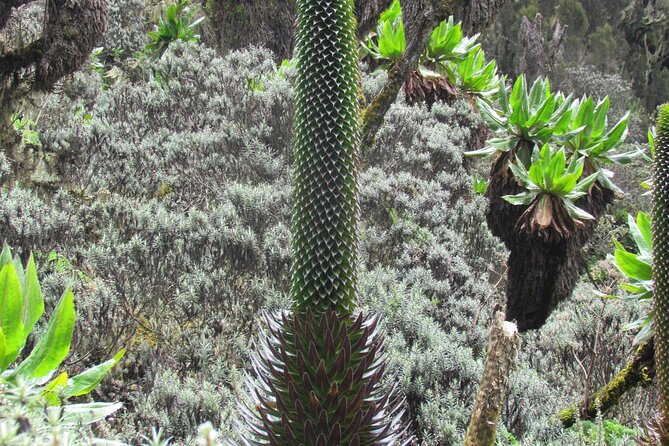
I especially like the plants here because they make the trek feel distinct from better-known African climbs. Giant heathers and enormous groundsels give the upper slopes an almost prehistoric look. These plants are tied to equatorial alpine Africa, with several species linked to the Albertine Rift.
The park also supports 70 mammal species and 217 bird species, including 19 Albertine Rift endemics. You should not book this as a wildlife safari, but the chance of hearing chimpanzees or seeing black and white colobus monkeys, blue monkeys, chameleons, and the Rwenzori turaco adds interest to the forest days.
More trekking days out of Kampala:
- 3 Days gorilla trekking Safari tour in Uganda
★ 5.0 · 121 reviews - 8-Day Murchison Falls, Chimp and Epic Gorilla Trekking Safari
★ 5.0 · 72 reviews - 5-Day Pearl of Africa Chimps and Gorilla Trekking Safari
★ 5.0 · 52 reviews
Day 1: Nyakalengijja to Nyabitaba Hut
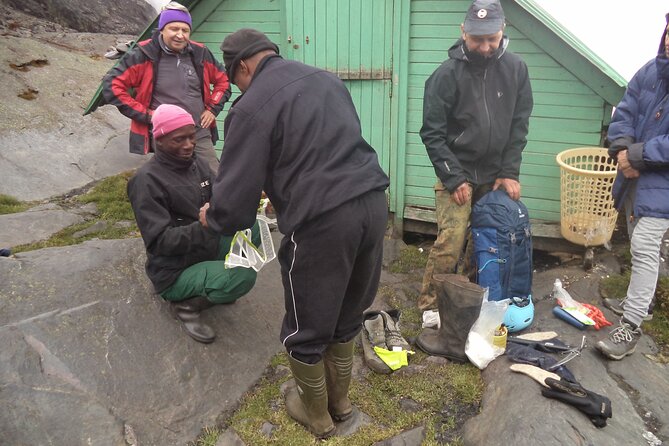
Your driver guide takes you to Nyakalengijja for a briefing and equipment check. This is an important start, not a box-ticking exercise. Since climbing gear is excluded from the price, use this time to confirm exactly what is available, what you need to hire, and what you must carry.
The trail begins through farmland before reaching the park boundary. From there, you enter thick forest and follow the Mubuku River. The route crosses the Mahoma River tributary, then begins a long, steep climb onto a broad ridge.
This first day covers about six to seven hours, with an elevation gain of roughly 1,036 meters. That is a serious opening day, especially if you have just arrived in Uganda and are not used to sustained uphill walking.
The forest gives the route a gentle introduction in terms of scenery, but not necessarily in terms of effort. You may hear chimpanzees and see black and white colobus monkeys or blue monkeys. The Rwenzori turaco is one of the most appealing possible sightings.
Nyabitaba Hut is your first overnight stop. I would use the evening to organize clothing, dry anything damp, and prepare your daypack. The early rhythm of this trek matters. You will need to keep moving without wasting energy on small tasks.
Day 2: Bamboo forest, slippery rock, and John Matte Hut
Day two is longer and more tiring. From Nyabitaba, the trail drops through forest to Kurt Shafer Bridge, below the meeting point of the Mubuku and Bujuku rivers. The route then enters bamboo forest and continues over slippery, moss-covered rock.
This is one of the days when good footwear matters most. The combination of moisture, moss, mud, and uneven rock can make a moderate distance feel slow. The description gives seven to eight hours of hiking and an elevation gain of about 854 meters.
At Nyamuleju rock shelter, you may see Mount Stanley and Mount Speke. These views provide a useful sense of the high country ahead, although cloud and fog can limit what you see.
The vegetation changes again as you pass into giant heather, lobelia, and groundsel country. The final approach includes a tiring bog before John Matte Hut. This is not polished walking. You will be stepping carefully, managing wet ground, and trying to keep your feet dry when the trail allows it.
Dinner and an overnight stay at the hut are included in the plan. Since meals are provided each day, the $1,400 cost covers more than the guiding itself. Still, confirm whether drinks, snacks, and special dietary needs are included, because the supplied details only specify breakfast, lunch, and dinner.
Day 3: Bujuku Lake and a shorter acclimatization day
Day three is shorter, at about four to five hours, with an elevation gain of approximately 457 meters. That relative pause is welcome after the previous day.
From John Matte Hut, the route drops to the Bujuku River and enters Lower Bigo Bog. Giant lobelias grow here, and crossing the bog involves jumping from tussock to tussock. You may get a foot into the freezing mud. Bring patience, waterproof protection, and a willingness to laugh when the mountain wins a small battle.
Upper Bigo Bog leads toward Bujuku Lake. The views open toward Mount Baker to the south and Mount Stanley to the west. Bujuku Hut sits in a narrow valley beneath Mount Baker and Mount Speke, near Stuhlmann Pass.
This is a useful acclimatization stop for anyone attempting Mount Stanley or Mount Speke, and it also gives you time to settle into the altitude before the Margherita attempt. Do not mistake the shorter walking time for an easy day. The bogs still demand balance, and the elevation can affect sleep, appetite, and energy.
Same country, a completely different few days:
- 3 Hours Guided Cycling Tour Across Lake Victoria
★ 5.0 · 151 reviews - Kampala’s Best Experience walking tour
★ 5.0 · 137 reviews - Lake Victoria Island Cycling Tour from Kampala
★ 5.0 · 120 reviews - Kampala Walking City Tours (Women Guided)
★ 5.0 · 115 reviews
Day 4: Groundsel Gully and the cold Elena Hut
Leaving Bujuku, you continue through more bog before climbing the steep slopes west of the lake. The route passes through Groundsel Gully, described in the itinerary as a magical forest. Here the plants and rock formations create one of the most unusual sections of the trek.
At a trail junction, the route to the right climbs toward Elena Hut and Mount Stanley. Another route leads toward Scott-Elliot Pass and Kitandara Lakes, while people not attempting Margherita Peak continue toward Kitandara Hut.
The Margherita group takes the steep trail over large boulders to Elena Hut. This day lasts about five to six hours and gains roughly 579 meters. The hut is described as cool and icy, so this is the point where a warm sleeping system and dry layers become especially important.
I like the way this day prepares you psychologically. You are no longer simply walking through striking vegetation. You are moving over rough rock toward a technical summit attempt. Dinner and the overnight stay at Elena are included.
Day 5: The Margherita Peak summit attempt
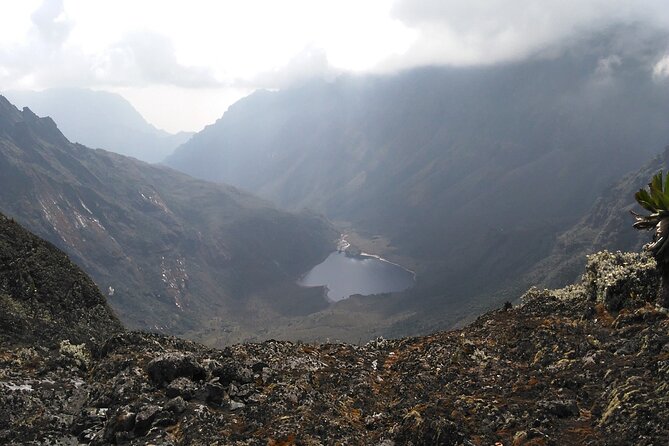
Summit day begins early. The climb to Margherita Peak takes about four to five hours, depending on weather and walking pace, followed by a two to three-hour descent to Elena Hut.
This is the hardest part of the trip. The route crosses three glaciers, slippery rock, ice, and exposed sections open on several sides. You climb onto the glaciers, cross the Stanley Plateau, and continue upward through fog, cold weather, and possible altitude sickness.
The supplied itinerary describes a demanding scramble to the summit, not a standard marked trail. That distinction matters. You should be ready for slow progress, careful foot placement, and changing conditions. The peak is 5,109 meters above sea level, and the height alone can make every movement feel expensive.
The summit views can be magnificent, but cloud may close in. I would judge success by safe movement and a sound decision, not just by standing on the highest point. A strong guide should be willing to turn the group around if conditions or altitude make the attempt unsafe.
The itinerary’s Day 5 text is cut off in places, and the following day begins from Kitandara, so confirm the exact post-summit sequence with Bujuku Eco Tours before departure. The listed plan clearly includes a return from the summit area and then a continuation toward Kitandara and the lower camps.
Day 6: Freshfield Pass and the route toward Guy Yeoman
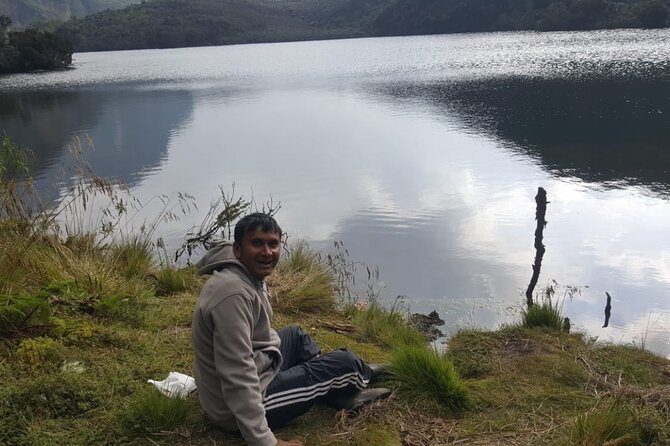
The sixth day is listed at six to seven hours. From Kitandara, the route climbs steeply up the headwall from the base of Mount Baker and continues along the mountain’s south side toward Freshfield Pass at 4,282 meters.
At the pass, you may see into Congo to the west and toward Mount Stanley to the north. These high views are one reason the return route is not just a long walk back to the vehicle. You continue through high alpine terrain before descending on steep, rocky trails.
The route passes Bujongolo rock shelter, identified as the base camp for the Duke of Abruzzi’s 1906 expedition. That detail gives the trail a mountaineering connection without requiring you to turn the trip into a history lesson.
The night is planned at Guy Yeoman Camp. After a summit attempt, this remains a demanding day. You will need to manage tired legs, wet clothing, and the temptation to hurry downhill. Careful pacing still matters.
Day 7: Completing the circuit at Mihunga Gate
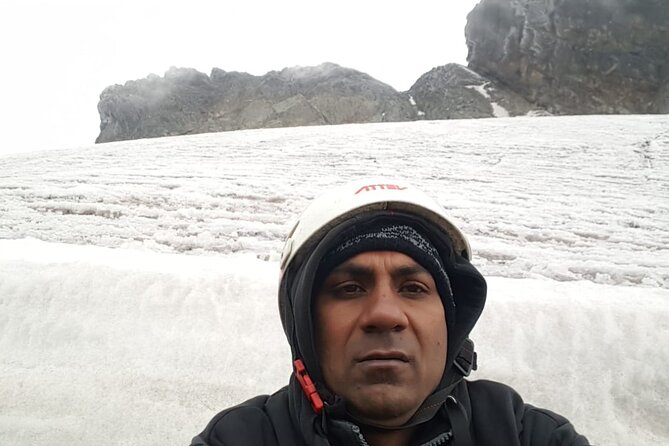
The final day descends below Guy Yeoman and follows the cliffs of Kichuchu. The muddy path crosses the Mubuku River twice through bamboo forest before climbing down toward Nyabitaba and completing the circuit.
The descent lasts about seven to eight hours. That is a full day, not a quick stroll to the gate. Downhill walking can be hard on knees and toes, especially after the summit and the steep sections of the previous days.
You finish at Mihunga Gate by evening. The experience then ends back at the meeting point, listed as Entebbe Airport. Because the advertised location is Kampala while the meeting point is Entebbe, ask for a precise pickup and drop-off plan before you pay.
What the $1,400 price gives you
At $1,400 per person, this is not a budget day hike. It is a seven-day private mountain expedition with meals, park travel, accommodation in mountain huts and camps, and support from a local operator.
The value is strongest if you want one company to coordinate the trek from airport pickup through the final descent. The private format also lets your group move at its own pace within the guide’s safety limits, rather than being tied to a large mixed party.
All seven breakfasts, lunches, and dinners are included. That removes one major planning problem in a remote mountain setting. You should still ask about water, snacks, drinks, tips, porter arrangements, park fees, and any transfer costs not spelled out in the tour details.
Climbing gear is not included. This is the most important price warning. The summit route involves glaciers, ice, exposed rock, and cold conditions, so ask for a complete equipment list. Do not assume ordinary hiking boots and rainwear will be enough.
The support people praise most
The operator, Bujuku Eco Tours & Travel Ltd, receives consistently positive comments for communication, organization, flexibility, and professional guiding. Specific names connected with past trips include Johnson, Geoffrey, and Joeffery.
If Johnson or Geoffrey is assigned to your group, you will have staff members who have been directly associated with successful Rwenzori and Margherita trips. I would still ask who your lead guide will be, how many support staff are included, and who makes the final call on summit safety.
The strongest practical advantage is the company’s reported flexibility. One long Uganda trip was adjusted for health reasons, and other groups praised quick communication and help with arrangements. That matters on a mountain where weather, fitness, and altitude can change the plan.
Who should book this trek?
I would recommend it to fit hikers who want a serious African mountain challenge and who value unusual plants, remote huts, and a private guiding arrangement. It suits someone who sees the journey as more than a summit photograph.
You should have a moderate physical fitness level at minimum, as the official information states. In practice, the long eight-hour days, steep climbs, bog crossings, cold huts, and altitude make this a poor choice for a casual walker.
I would also recommend it to hikers who are comfortable with uncertainty. Weather can affect the summit timing, and the route includes exposed areas and glacier travel. If you want a predictable holiday with soft beds and short walks, choose another Uganda experience.
Booking details worth checking first
Confirmation is provided at booking, and pickup is offered. The stated start point is Entebbe Airport, while the tour summary gives Kampala as the location, so request the exact transfer schedule.
The activity is listed for Monday through Friday, from 7:00 AM to 5:00 PM, during the published operating period. The trip is private, and only your group participates.
Cancellation is free up to 24 hours before the start time for a full refund. A minimum group size applies, and if the operator cancels because that minimum is not reached, you are offered another date or experience, or a full refund.
Should you book the Margherita Peak trek?
Book it if you want a demanding, well-supported mountain expedition with dramatic changes in plants and terrain, and if you are prepared for cold, wet, steep, and exposed conditions.
I would pause before booking if you have limited hiking experience, are uneasy with glaciers, or have not arranged suitable climbing equipment. Ask detailed questions about gear, summit conditions, the exact Day 5 and Day 6 route, meals beyond the three daily basics, and airport transfers.
For the right hiker, this is a powerful seven-day trip. You get the forest, wildlife, bogs, giant alpine plants, high passes, glaciers, and a genuine attempt on Uganda’s highest peak. The price is reasonable for the level of organization, but only after you confirm what the gear and support package actually covers.
FAQ
How high is Margherita Peak?
Margherita Peak reaches 5,109 meters above sea level.
How long is the trek?
The advertised duration is approximately seven days.
Where does the tour start?
The meeting point is listed as Entebbe Airport in Uganda. The tour summary also identifies Kampala as the location, so you should confirm the exact pickup plan.
Where does the activity end?
The activity ends back at the meeting point after the trek.
Is pickup available?
Yes. Pickup is offered.
Is this a private tour?
Yes. Only your group participates in the activity.
What meals are included?
Breakfast, lunch, and dinner are listed as included for all seven days.
Is climbing equipment included?
No. Climbing gear is specifically listed as not included.
How difficult is the trek?
The activity requires a moderate level of physical fitness, but the route includes long hiking days, steep climbs, bogs, slippery rock, glaciers, ice, exposed sections, cold weather, and altitude sickness risk.
Can I cancel for a full refund?
Yes. You can cancel at least 24 hours before the experience start time for a full refund. Cancellations or changes made less than 24 hours before the start time are not accepted for a refund.
Latest into the Kampala lineup
- Uganda: 3-Day Gorilla Experience from Entebbe★ 5.0 · 2 reviews
- Uganda Equator Tour From Kampala To Kayabwe★ 5.0 · 4 reviews
- Uganda: 1-Day Murchison Falls Park Safari with Boat cruise★ 5.0 · 3 reviews
- 3-Day Mind Refreshing in Murchison Falls National Park★ 5.0 · 4 reviews
- Entebbe kampala airport transfers★ 5.0 · 3 reviews
- Weekend Package B★ 5.0 · 7 reviews
- 15 Day Gorillas, Chimps and Big 5 Safari Tour★ 5.0 · 5 reviews
- Uganda 4 days Gorilla Trekking★ 5.0 · 3 reviews
Hiking & Trekking, compared.
3 Days gorilla trekking Safari tour in Uganda
Read our review →
8-Day Murchison Falls, Chimp and Epic Gorilla Trekking Safari
Read our review →
5-Day Pearl of Africa Chimps and Gorilla Trekking Safari
Read our review →
3-Day Tour to Uganda – Gorilla Trekking Bwindi Forest
Read our review →
4-Day Uganda Gorilla Trekking and Wildlife Safari
Read our review →
Private 3 Day Gorilla Trekking Safari in Uganda
Read our review →
8-Day Murchison Falls, Chimp and Epic Gorilla Trekking
Read our review →Browse the lists this tour appears in